

If you’ve ever wondered why you’re eating keto friendly foods but still not seeing the results you expect, the problem is rarely your willpower; it’s your macro ratios.
Most foods labeled keto friendly won’t kick you out of ketosis. But there’s a meaningful difference between foods that merely allow ketosis and foods that actively fuel it.
That distinction is precisely what the Pure Keto™ Standard exists to define.
The Pure Keto™ Standard is our proprietary macronutrient-based scoring framework, developed by Ketofriendly.com in 2026. It presents our original research and methodology for classifying foods and meals based on their support for ketogenic metabolism. This standard powers every food review, product certification, and educational resource we publish.
The Four Zones
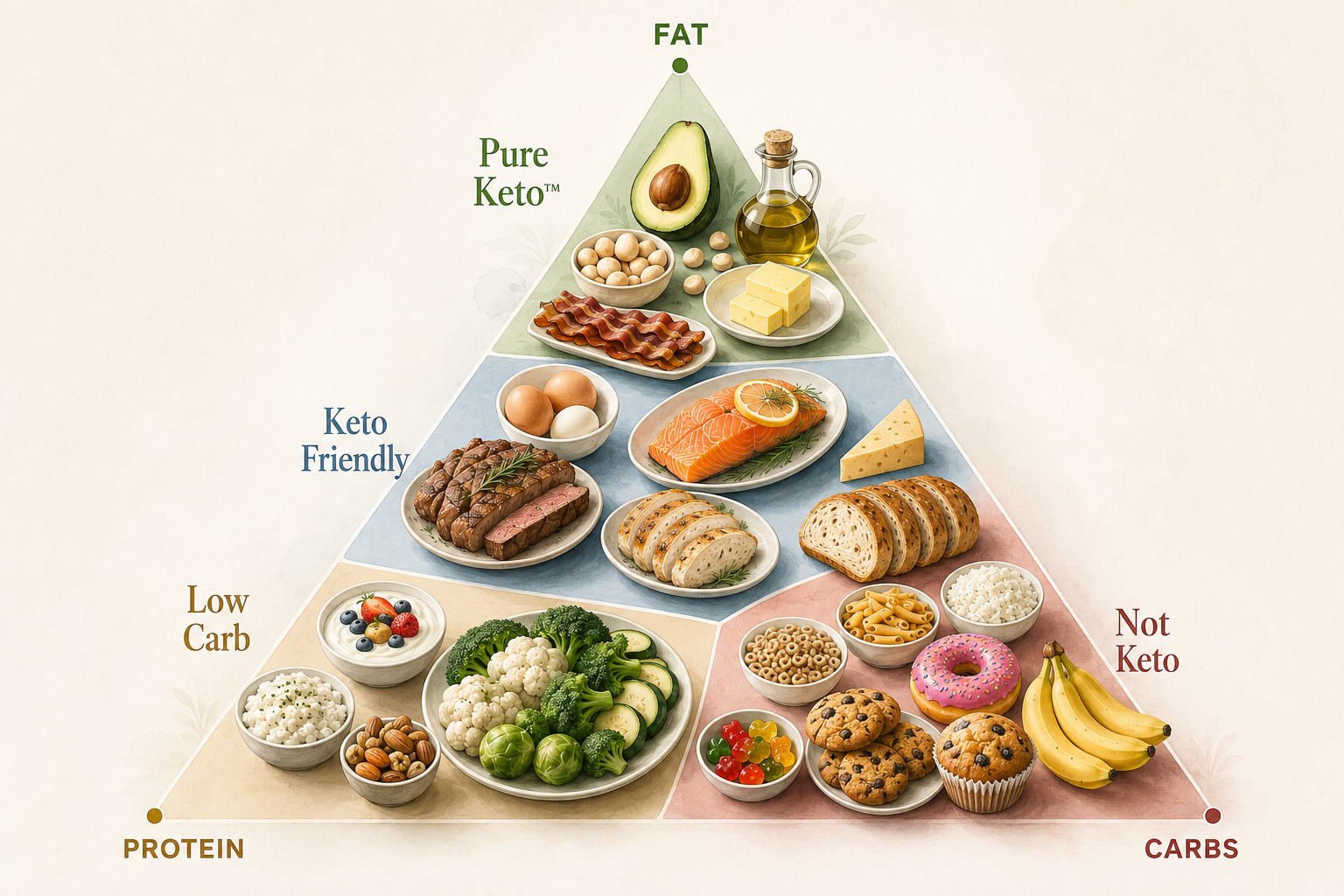
Not all keto foods are created equal. The Pure Keto Standard classifies every food and meal into one of four zones based on its macronutrient ratio of fat, protein, and net carbohydrates.
Pure Keto™
Foods in the Pure Keto™ zone are active fuel for ketosis. They are high in fat, low in net carbohydrates, and have a protein level that supports rather than disrupts fat burning. Bacon, butter, avocado, ribeye, macadamia nuts, and MCT oil are classic Pure Keto™ foods. When the majority of your meals come from this zone, your body has everything it needs to produce and sustain ketones.
Keto Friendly
Keto friendly foods won’t kick you out of ketosis but they aren’t driving ketosis either. They have moderate fat content and low to moderate net carbohydrates when applied to the Pure Keto Net Carb Standard. A keto tortilla, full-fat Greek yogurt, or a small serving of dark chocolate fall here. These foods are fine as part of a ketogenic diet, but they work best when combined with Pure Keto foods in the same meal.
Low Carb
Low-carb foods have controlled carbohydrate levels but lack the fat content to support ketosis on their own. Chicken breast, tuna, shrimp, and cottage cheese fall into this zone. They are healthy foods and appropriate for low-carbohydrate diets, but people who rely on them as their primary protein source often wonder why they stall on keto. The reason is that without sufficient dietary fat, the body has less incentive to produce ketones even when carb intake is low.
Not Keto
Foods in the Not Keto zone have carbohydrate levels high enough to interrupt ketosis in most people. White rice, honey, bread, most fruits, and beer fall here. This is not a judgment on these foods as part of a balanced diet; it is simply an accurate classification of their effect on ketogenic metabolism.
How We Plot Foods: the Ternary Chart
The Pure Keto Standard uses a ternary chart to visualize where any food sits across all three macronutrients simultaneously. Unlike a simple carb counter or a two-axis graph, a ternary chart shows fat, protein, and carbohydrates as three competing forces in a triangle. Every food lands at a point determined by the ratio of all three, not just one or two.
Each corner of the triangle represents 100% of one macronutrient. A food that is pure fat sits at the fat corner. A food that is pure sugar sits at the carb corner. Most real foods land somewhere in the middle, pulled toward one corner or another depending on their macro profile.
The four zones are mapped directly onto the triangle:
The Pure Keto zone occupies the fat corner, high fat, low carbs, controlled protein. Foods here are the foundation of a ketogenic diet.
The Keto Friendly zone sits adjacent to Pure Keto, still fat-dominant but with slightly higher carbs or protein that moves the food away from the pure fuel category.
The Low Carb zone covers foods pulled toward the protein corner — low carbs but insufficient fat to drive ketosis consistently.
The Not Keto zone covers the carb corner and everything approaching it — foods where carbohydrate content is high enough to interrupt fat burning in most people.
Macronutrient ratios shown as percentage of total calories. Pure Keto Carb Standard applied: natural fiber fully subtracted, added fiber discounted 50%. Hover any dot to see exact values.
The chart is interactive. Hover over any food to see its exact macro ratio and zone classification. Use the filter buttons to isolate each zone and see which foods belong there.
The Pure Keto Net Carb Standard: Why Label Math Is Not Enough
The standard “total carbs minus fiber” formula printed on nutrition labels was designed to identify fibers with beneficial health effects. It was not designed to protect ketosis. Those are different standards, and conflating them is one of the most common reasons people stall on keto despite eating foods they believe are compliant.
The Pure Keto Net Carb Standard uses a tiered system grounded in peer-reviewed human absorption data. The question for every ingredient is simple: how much of it actually enters the bloodstream as glucose? The answer determines how much, if any, can be deducted from total carbohydrates.
Fiber Deductions
Not all fibers behave the same way in the body. The Pure Keto Standard classifies fibers into three tiers based on confirmed human absorption data.
| Tier | Deduction | Notes |
|---|---|---|
| Tier 1 | 100% | Confirmed non-digestible in peer-reviewed human studies. Fermented to short-chain fatty acids or excreted unchanged. No meaningful glucose contribution. Examples: natural plant fiber, inulin, chicory root fiber, psyllium, polydextrose. |
| Tier 2 | 50% | Partially digestible or inconsistent absorption data in human studies. A conservative middle position. Also, the default for any unlisted fiber ingredient is pending review. Examples: soluble corn fiber, resistant maltodextrin, high amylose starch. |
| Tier 3 | 0% | Labeled as dietary fiber on nutrition panels but confirmed to raise blood glucose in peer-reviewed human trials. Every gram counts as a full carbohydrate. Primary example: isomalto-oligosaccharides (IMO), also labeled VitaFiber or IMO syrup. |
IMO, the most important Tier 3 example is because it appears widely in keto-labeled products. It is an FDA-approved dietary fiber. Multiple randomized controlled trials in human subjects confirm that it produces blood glucose spikes and insulin responses comparable to dextrose. Products that list IMO, VitaFiber, or isomaltooligosaccharides in the ingredient panel receive zero fiber deduction under the Pure Keto Standard, regardless of what the nutrition label declares.
Sugar Alcohol Deductions
Sugar alcohols are evaluated separately from fiber. Each is assessed on actual small intestine absorption and downstream glucose metabolism, not glycemic index. Listed from most to least keto-safe:
| Sugar Alcohol | Deduction | Notes |
|---|---|---|
| Erythritol | 100% | Absorbed but excreted unchanged in urine. Zero glucose contribution. |
| Mannitol | 100% | Low absorption; absorbed portion excreted unchanged. No glucose metabolism. |
| Allulose | 100% | Absorbed but not metabolized. FDA excludes it from total and added sugars. Verify per product — some labels already exclude it. |
| Sorbitol | 75% | Partially converted to fructose in the liver. Real-meal absorption is higher than fasted studies suggest. |
| Xylitol | 50% | Wide absorption range across studies. Metabolized via a non-glucose pathway but produces a small, real blood glucose rise. |
| Maltitol | 50% | Roughly 40-60% absorbed and metabolized as glucose. Most keto labels subtract 100% — this is incorrect. Count 50% of declared maltitol as net carbs. |
The Default Rule for Unlisted Ingredients
The food industry regularly introduces novel fiber and sweetener ingredients. When an ingredient does not appear in the Pure Keto Fiber Registry, the Pure Keto Standard assigns it Tier 2 with a 50% deduction pending review. Manufacturers seeking Pure Keto certification that use unlisted ingredients must submit peer-reviewed human absorption data before certification can be granted.
For the Complete Ingredient Reference
The tables above are a working summary. The Pure Keto Fiber Registry is the full citation-sourced classification of every fiber ingredient recognized by the FDA, the complete sugar alcohol deduction table, and the five-step methodology used to assign each tier. If you are evaluating a packaged food, an ingredient panel, or a product seeking certification, the Registry is your reference.
View the Pure Keto Fiber Registry
The formula in plain terms:
Pure Keto Net Carbs = total carbohydrates, minus natural fiber, minus added soluble fiber multiplied by 0.5, minus erythritol, minus other sugar alcohols multiplied by 0.5, with no subtraction for maltitol.
This calculation is applied to every food review, every product certification, and every meal analysis published on KetоFriendly.com. It is also the standard used in our Pure Keto Certification audits when brands apply to have their products evaluated.
Pure Keto Is a Meal Standard, Not a Food List
This is the insight that most keto resources miss entirely.
A keto tortilla is Keto Friendly. Chicken breast is Low Carb. Full fat yogurt is Keto Friendly. Each of these foods, evaluated individually, clears the basic threshold of not disrupting ketosis. But if your typical lunch is a chicken wrap made with a keto tortilla and a side of yogurt, your overall meal macro ratio is sitting firmly in the Low Carb zone — not Pure Keto, and possibly not even Keto Friendly depending on portions.
This is why people stall. Not because they are eating the wrong foods by name, but because their meal compositions are never reaching the fat ratio that actually drives ketosis.
The Pure Keto Standard evaluates meals the same way it evaluates individual foods — by plotting the combined macro ratio on the ternary chart. A meal that combines bacon, eggs, and avocado lands deep in the Pure Keto zone because the combined fat ratio dominates. A meal that combines chicken breast, a keto tortilla, and blueberries lands in Low Carb territory despite every individual ingredient being marketed as keto safe.
The difference between a Keto Friendly meal and a Pure Keto meal is almost always the fat source. Add butter to the pan. Slice of avocado on the side. Use heavy cream in your coffee. These additions shift the entire meal’s macro ratio toward the fat corner of the triangle without adding meaningful carbohydrates. That shift is the difference between a body that is flirting with ketosis and a body that is running on it.
Build your meals from the fat corner outward.
Start with a Pure Keto anchor — bacon, ribeye, butter, MCT oil, heavy cream, eggs, avocado. Then add Keto Friendly and Low Carb foods around that anchor. The anchor sets the macro foundation. Everything else builds on it. As long as your anchor is strong enough, moderate additions from the Keto Friendly zone will not pull your overall meal out of the Pure Keto range.
This is the practical application of the Pure Keto Standard and it is how we recommend thinking about every meal, every day.
No foods added yet…
—
Add foods to see where your meal lands.
Macronutrient ratios calculated as percentage of total calories. Pure Keto Net Carb Standard applied. Fat, protein, and net carbohydrate values are approximate per standard serving.
Use the meal composer above to test your own meals. Add the foods you typically eat together and watch where the combined macro ratio lands on the zone scale. If your typical meals are landing in Keto Friendly or Low Carb, look for the missing fat anchor and add it.
The Pure Keto Standard: A Living Document
The thresholds, calculations, and zone definitions in this standard reflect the current state of nutritional science as we understand it. We update this document when new research warrants a change. Every update is dated and documented.
If you are a food brand interested in having your products evaluated and certified under the Pure Keto Standard, visit our certification page to learn more about the process.
This standard was published on May 5, 2026, and is the intellectual foundation of the Pure Keto certification program operated by KetоFriendly.com.
Frequently Asked Questions
What is the difference between Pure Keto and keto friendly?
Pure Keto describes foods and meals with a macro ratio that actively drives ketosis, high fat, controlled protein, and very low net carbohydrates. Keto friendly foods are those that do not disrupt ketosis but are not necessarily driving it. Both have a place in a ketogenic diet. The distinction matters when you are troubleshooting a stall or optimizing for performance rather than just compliance.
Why does protein matter in a keto diet?
Excess dietary protein can be converted to glucose through a process called gluconeogenesis.[1,2] This does not mean protein is bad; it means the ratio of fat to protein matters, not just the absence of carbohydrates. Foods like chicken breast and tuna have zero carbs, but their high protein-to-low-fat ratio means they belong in the Low Carb zone, not the Pure Keto zone. This is one of the most common misunderstandings in ketogenic dieting.
Why do you discount added fiber instead of subtracting it fully?
Research on added soluble fibers, such as soluble corn fiber and chicory inulin, shows a reduced but non-zero glycemic impact. Unlike natural intrinsic fiber, which has a strong consensus behind full subtraction, added fibers are processing aids whose metabolic effects vary by individual. A 50% discount reflects the best available evidence without overclaiming.
Why is maltitol not subtracted?
Maltitol has a glycemic index of approximately 35 compared to glucose at 100. It raises blood sugar meaningfully in most people and can interrupt ketosis. It appears on nutrition labels in the fiber or sugar alcohol rows of many products marketed as keto or sugar-free. The Pure Keto Net Carb Standard treats every gram of maltitol as a full net carbohydrate because the evidence does not support treating it otherwise.
Note: Some certification bodies permit maltitol in certified products, citing its lower glycemic index relative to table sugar. The Pure Keto Net Carb Standard takes a stricter position based on maltitol’s stronger insulin response compared to other sugar alcohols and documented experiences of people with insulin resistance.
How do I get my product certified under the Pure Keto Standard? Visit our certification page for information on the Pure Keto Certification program, including eligibility, the audit process, and licensing options.
References
- Fromentin G, et al. “Gluconeogenesis and protein-induced satiety.” British Journal of Nutrition, 2012. pubmed.ncbi.nlm.nih.gov/21767449
- Tessari P, et al. “Effect of long-term dietary protein intake on glucose metabolism in humans.” Diabetologia, 2002. pubmed.ncbi.nlm.nih.gov/11079744
- Baxter NT, et al. “Dynamics of Human Gut Microbiota and Short-Chain Fatty Acids in Response to Dietary Interventions with Three Fermentable Fibers.” mBio, 2019. Referenced in: Guo Q, et al. “The Effects of Soluble Dietary Fibers on Glycemic Response.” Foods, 2022. pmc.ncbi.nlm.nih.gov/articles/PMC9736284
- Lim J, et al. “The Role of Soluble Corn Fiber on Glycemic and Insulin Response.” Nutrients, 2020. pubmed.ncbi.nlm.nih.gov/32235569
- Noda K, et al. “Glycemic response to erythritol: a review of clinical evidence.” European Journal of Clinical Nutrition, 1994. Referenced across multiple systematic reviews confirming GI of zero for erythritol.
- Benson J, et al. “Maltitol: Blood Sugar and Insulin Impact.” BBD Nutrition, 2026. bbdnutrition.com/2026/02/05/maltitol-impact-on-blood-sugar-and-insulin Note: Maltitol GI is reported between 35 and 52, depending on the source and form (powder vs syrup). All sources confirm meaningful glycemic impact, distinguishing it from other sugar alcohols.