

Most people who start keto do it right. They cut carbs, they read labels, they swap bread for lettuce wraps and sugar for erythritol. And many of them still stall. They lose weight for a few weeks and then plateau. Or they never quite feel the mental clarity and sustained energy that keto is supposed to deliver. The problem is rarely effort. The problem is that “keto friendly” is not a precise enough standard.
Pure Keto is a more precise standard. It is a macronutrient-based scoring framework developed by Ketofriendly.com that classifies every food and meal into one of four zones based on how it actually performs in the body — not just whether it keeps carbs low, but whether it actively fuels ketogenic metabolism. The difference matters more than most people realize.
Pure Keto vs Keto: What Is the Difference?
Standard keto is defined by what you avoid. Keep net carbs under 50 grams, avoid sugar, avoid grains, avoid most fruit. That framework works as a starting point but it leaves a gap that trips up a lot of people.
The gap is this: two meals can both be technically keto and produce completely different metabolic results. A plate of grilled chicken breast with steamed broccoli is keto. A plate of ribeye cooked in butter with avocado on the side is also keto. Both are low carb. But only one of them gives your body the fat it needs to run ketosis efficiently. The first meal keeps you out of trouble. The second meal actively fuels the metabolic state you are trying to achieve.
Pure Keto is the framework that captures that distinction. It scores foods and meals not just on what they exclude but on what they deliver — specifically, the ratio of fat to protein to net carbohydrates as a percentage of total calories. A food that is genuinely keto-optimized looks very different from a food that is merely low carb, and that difference shows up clearly on the Pure Keto scoring chart.
The Pure Keto™ Standard is a proprietary framework developed and published by Ketofriendly.com in 2026. It is the methodology behind every food score, product review, and certification on this site. The full methodology, including the net carb calculation system and fiber classification tiers, is published at the Pure Keto™ Standard.
The Four Pure Keto Zones
Every food and meal scores into one of four zones. The zones are defined by macronutrient ratios — the percentage of total calories that come from fat, protein, and net carbohydrates. Here is what each zone means in practice.
Pure Keto
The Pure Keto zone is the target. Foods here are high in fat, very low in net carbohydrates, and have a protein level that supports rather than disrupts fat burning. When you eat predominantly from this zone, your body has the fat substrate it needs to produce ketones consistently and your insulin stays low enough to keep fat burning running in the background.
The macro profile that defines the Pure Keto zone: fat at 60% or more of total calories, net carbohydrates at 10% or less. Foods that land here include butter, MCT oil, olive oil, bacon, ribeye, cheddar, heavy cream, macadamia nuts, avocado, and eggs. These are not just low carb foods. They are high fat foods with a macro ratio that actively drives ketosis rather than merely permitting it.
MCT oil is the most extreme example in this zone — it is 100% fat with zero carbohydrates and zero protein, and it converts directly to ketones within minutes of consumption. It is the clearest illustration of what Pure Keto means at the food level.
Keto Friendly
The Keto Friendly zone covers foods that will not interrupt ketosis but are not driving it either. Fat content is still meaningful — above 35% of total calories — but carbohydrates or protein are elevated enough to shift the food away from the pure fuel category. Full-fat Greek yogurt, keto tortillas, small servings of dark chocolate, and peanut butter fall into this zone.
These foods are fine as part of a ketogenic diet. The key is context. A Keto Friendly food eaten alongside Pure Keto foods in a well-constructed meal can contribute to a meal that scores Pure Keto overall. The same food eaten as a standalone snack or paired with other Keto Friendly foods may produce a meal that falls short of the fat ratio needed to sustain ketosis efficiently.
Low Carb
The Low Carb zone is where a lot of careful keto eaters unknowingly spend most of their time. Foods here have controlled carbohydrate levels but lack the fat content to support ketosis on their own. Chicken breast, tuna, shrimp, egg whites, and cottage cheese are classic Low Carb zone foods.
These are healthy foods. They are appropriate for low-carbohydrate diets and they serve an important role in a balanced ketogenic eating pattern. But people who rely on them as their primary protein source and pair them with vegetables and light dressings often stall. The reason is simple: without sufficient dietary fat, the body has less metabolic incentive to produce ketones even when carbohydrate intake is low. Protein can be converted to glucose through gluconeogenesis, which blunts the ketogenic signal.
The fix is not to avoid Low Carb foods. It is to pair them with fat anchors — butter, olive oil, avocado, heavy cream — that shift the meal’s overall macro ratio toward the Pure Keto zone.
Not Keto
The Not Keto zone covers foods where carbohydrate content is high enough to interrupt ketosis in most people. White rice, bread, most fruit, beer, oatmeal, and honey fall here. This is not a moral judgment on these foods. Many of them are nutritious in other dietary contexts. The classification is purely about their effect on ketogenic metabolism.
Honey is one of the most searched examples in this zone. It is natural, it has trace antioxidants, and it feels like it should be different from table sugar. At 17 grams of net carbs per tablespoon with zero fiber and zero fat, there is nothing the Pure Keto Net Carb Standard can do with it. Every gram counts, and it will interrupt ketosis in most people at any meaningful serving size.
The Pure Keto Food Scoring Triangle
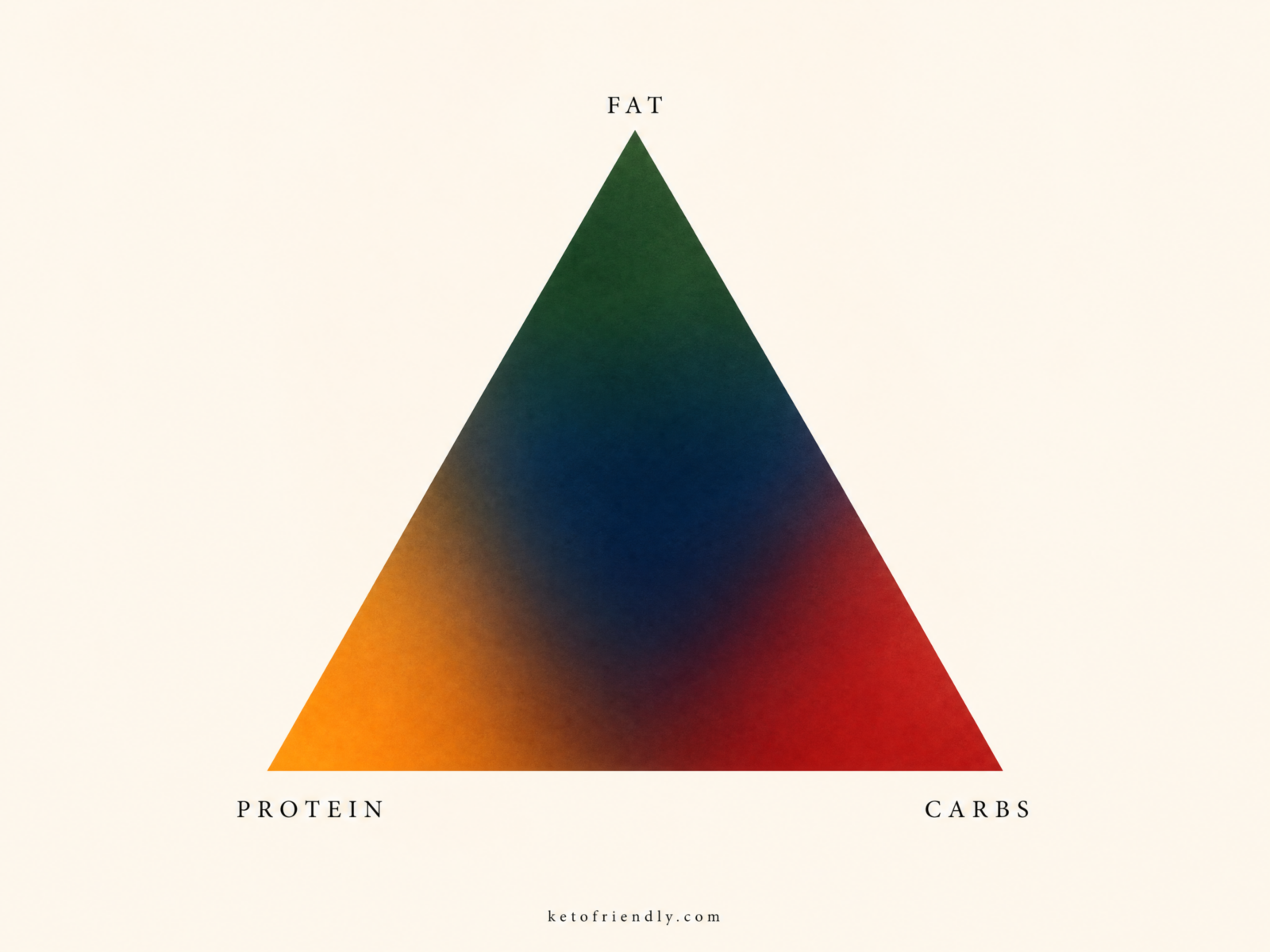
The tool that makes the Pure Keto Standard visual is the ternary chart. Most nutrition tools plot one or two variables at a time — carbs vs calories, fat vs protein. A ternary chart plots all three macronutrients simultaneously, which is what you need to actually see where a food sits in relation to the ketogenic ideal.
The triangle has three corners. The top corner represents 100% fat. The bottom left represents 100% protein. The bottom right represents 100% net carbohydrates. Every food lands at a point determined by the ratio of all three. A food that is pure fat — like MCT oil or butter — sits at the fat corner. A food that is pure sugar — like honey — sits at the carb corner. Most real foods land somewhere in the triangle, pulled toward one corner or another.
The four zones are mapped directly onto the triangle. The Pure Keto zone occupies the fat corner. Moving toward the right pulls a food into Keto Friendly territory. Moving further right or down toward the carb corner takes a food into Low Carb and then Not Keto territory. The interactive chart below lets you explore where any food sits and filter by zone.
Macronutrient ratios shown as percentage of total calories. Pure Keto Carb Standard applied: natural fiber fully subtracted, added fiber discounted 50%. Hover any dot to see exact values.
The Pure Keto Net Carb Standard
The net carb calculation is where the Pure Keto Standard diverges most significantly from standard keto label math. The conventional formula — total carbs minus fiber — was designed to identify fibers with beneficial health effects. It was not designed to protect ketosis, and it has a meaningful blind spot that affects a large number of packaged keto products.
The Pure Keto Net Carb Standard applies tiered deductions based on peer-reviewed human absorption data. The question for every ingredient is the same: how much of this actually enters the bloodstream as glucose? The answer determines the deduction.
Natural plant fiber is fully deductible — it does not contribute to blood glucose. Common added fibers like inulin, chicory root fiber, and psyllium are also fully deductible based on confirmed human absorption data. But not all labeled dietary fiber behaves this way.
Isomalto-oligosaccharides — also labeled IMO, VitaFiber, or isomaltooligosaccharides — are FDA-approved dietary fiber that appears widely in keto-labeled products. Multiple randomized controlled trials in human subjects confirm that IMO raises blood glucose and produces insulin responses comparable to dextrose. Under the Pure Keto Net Carb Standard it receives zero deduction. Every gram counts as a full carbohydrate regardless of what the nutrition label declares.
Sugar alcohols are handled with the same evidence-based approach. Erythritol and allulose receive a 100% deduction because they produce no meaningful blood glucose response. Maltitol receives a 50% deduction — not the 100% deduction most keto products claim — because it is absorbed and metabolized as glucose at roughly 40 to 60% of a normal serving. The full classification of every fiber and sugar alcohol ingredient, with citations, is at the Pure Keto™ Fiber Registry.
How to Build a Pure Keto Meal
Understanding the zones is one thing. Building meals that land in the Pure Keto zone consistently is the practical skill. The key concept is the fat anchor — a high-fat ingredient added to any meal that shifts its overall macro ratio toward the fat corner of the triangle.
The fat anchor does not need to be exotic. Butter, olive oil, avocado, heavy cream, cheese, and MCT oil are all effective fat anchors. The principle is simple: if your meal’s protein or carbohydrate content is pulling it toward the Low Keto or Keto Friendly zone, adding a fat-dense ingredient shifts the entire meal’s ratio toward Pure Keto.
Here are three worked examples:
Table block:
| Base Meal | Zone Without Anchor | Fat Anchor Added | Zone With Anchor |
|---|---|---|---|
| Grilled chicken breast + steamed broccoli | Low Carb | 2 tbsp butter + olive oil drizzle | Keto Friendly / Pure Keto |
| Greek yogurt 2% | Keto Friendly | Full-fat yogurt + 1 tbsp MCT oil | Pure Keto |
| Tuna salad (light mayo) | Low Carb | Full-fat mayo + avocado | Pure Keto |
The meal composer below lets you build any meal and see where it lands on the ternary chart in real time. Adjust ingredients and watch the dot move.
No foods added yet…
—
Add foods to see where your meal lands.
Macronutrient ratios calculated as percentage of total calories. Pure Keto Net Carb Standard applied. Fat, protein, and net carbohydrate values are approximate per standard serving.
Pure Keto Food Guide: Scored by Zone
The table below covers 25 common foods with their Pure Keto zone and a brief note on why they score where they do. Foods with dedicated scoring articles are linked.
| Food | Zone | Note |
|---|---|---|
| Butter | Pure Keto | 100% fat. The cleanest fat anchor available. |
| MCT oil | Pure Keto | 100% fat, converts directly to ketones. Full review |
| Olive oil | Pure Keto | 100% fat. Ideal for dressings and low-heat cooking. |
| Bacon | Pure Keto | 72% fat, 28% protein. Classic Pure Keto food. |
| Ribeye | Pure Keto | 68% fat, 32% protein. Fat-to-protein ratio is ideal. |
| Avocado | Keto Friendly | 77% fat, 18% net carbs after fiber. A strong fat anchor, but the carbs keep it just outside Pure Keto. |
| Macadamia nuts | Pure Keto | Highest fat of any nut at 88% of calories. |
| Eggs | Pure Keto | 63% fat, 34% protein, 3% carbs. Versatile Pure Keto base. |
| Heavy cream | Pure Keto | 95% fat. Most effective dairy fat anchor. |
| Cheddar cheese | Pure Keto | 74% fat. Portable and easy fat anchor. |
| Salmon | Keto Friendly | 52% fat, 48% protein. Just under the 60% fat line; add butter or avocado to reach Pure Keto. |
| Almonds | Keto Friendly | 72% fat but 14% net carbs pulls it out of Pure Keto. |
| Peanut butter | Keto Friendly | 72% fat, 11% net carbs. Portion size matters. |
| Dark chocolate 85% | Keto Friendly | 67% fat, 25% net carbs. Borderline — keep servings small. |
| Full-fat Greek yogurt | Keto Friendly | Moderate fat, moderate carbs. Works well with a fat anchor. |
| Whole milk | Low Carb | 49% fat, 30% net carbs. The lactose pushes it past the Keto Friendly limit. |
| Chicken breast | Low Carb | 11% fat, 89% protein. Needs a fat anchor to approach Pure Keto. |
| Tuna canned | Low Carb | 4% fat, 94% protein. Strong fat anchor required. |
| Shrimp | Low Carb | 10% fat, 84% protein. Pairs well with butter or olive oil. |
| Cottage cheese | Low Carb | 20% fat, 24% net carbs. Better with full-fat cream added. |
| Broccoli | Not Keto | 10% fat, 60% net carbs on its own. Cooked in butter the plate scores Pure Keto. |
| Blueberries | Not Keto | 90% net carbs. High antioxidant value but not keto compatible. |
| Honey | Not Keto | 100% net carbs. 17g per tbsp, zero deductions. Full review |
| White rice | Not Keto | 89% net carbs. No fat, no fiber benefit. |
| Banana | Not Keto | 92% net carbs. Natural but not keto compatible. |
What Pure Keto Is Not
Pure Keto is a scoring framework, not a diet plan, a brand, or a calorie restriction system. It does not tell you how much to eat. It does not prescribe meal timing, intermittent fasting windows, or supplement protocols. It classifies foods and meals by their macronutrient ratio and their likely effect on ketogenic metabolism. What you do with that information is up to you.
It is also not a judgment on foods outside the Pure Keto zone. Honey is Not Keto. That does not make honey a bad food. In other dietary contexts it has genuine nutritional value. The Pure Keto Standard is a tool for people who have chosen a ketogenic approach and want to understand exactly how each food affects that goal. It does not claim authority over any other dietary framework.
Finally, Pure Keto is not a static list. The Pure Keto™ Fiber Registry is updated as new ingredients enter the market and new human absorption data becomes available. The standard is grounded in peer-reviewed science, and when the science updates, the standard updates with it.
Pure Keto Certification
The Pure Keto™ Standard is also a certification framework for food manufacturers and supplement brands. A product that meets the Pure Keto Standard — clean macros, verified net carb calculation, no IMO or other deceptive fiber ingredients — can carry the Pure Keto Certified mark.
Certification exists at three levels. The free digital badge is available to any product that passes the Pure Keto Net Carb Standard review. Paid label certification covers physical packaging and retail use. Enterprise certification covers full product lines with ongoing compliance monitoring.
The certification program is designed to give consumers a reliable signal in a market where “keto friendly” on a label means very little. If a product carries the Pure Keto Certified mark, the macros have been verified, the net carb calculation has been audited, and the ingredient panel has been checked against the Pure Keto Fiber Registry. Full details and the application process will be available at the certification page shortly.
References
- Paoli A, et al. Beyond weight loss: a review of the therapeutic uses of very-low-carbohydrate (ketogenic) diets. European Journal of Clinical Nutrition, 2013. pubmed.ncbi.nlm.nih.gov/23801097
- Volek JS, Phinney SD. The Art and Science of Low Carbohydrate Performance. Beyond Obesity, 2012.
- Vandenberghe C, et al. Tricaprylin alone increases plasma ketone response more than coconut oil or other medium-chain triglycerides. Frontiers in Nutrition, 2017. pubmed.ncbi.nlm.nih.gov/28523250
- Atkinson FS, et al. International tables of glycemic index and glycemic load values: 2008. Diabetes Care, 2008. pubmed.ncbi.nlm.nih.gov/18835944
- KetоFriendly.com. Pure Keto™ Standard. ketofriendly.com/pure-keto-standard/
- KetоFriendly.com. Pure Keto™ Fiber Registry. ketofriendly.com/pure-keto-fiber-registry/
- KetоFriendly.com. Is Honey Keto Friendly? ketofriendly.com/is-honey-keto-friendly/
- KetоFriendly.com. Best MCT Oil. ketofriendly.com/best-mct-oil/